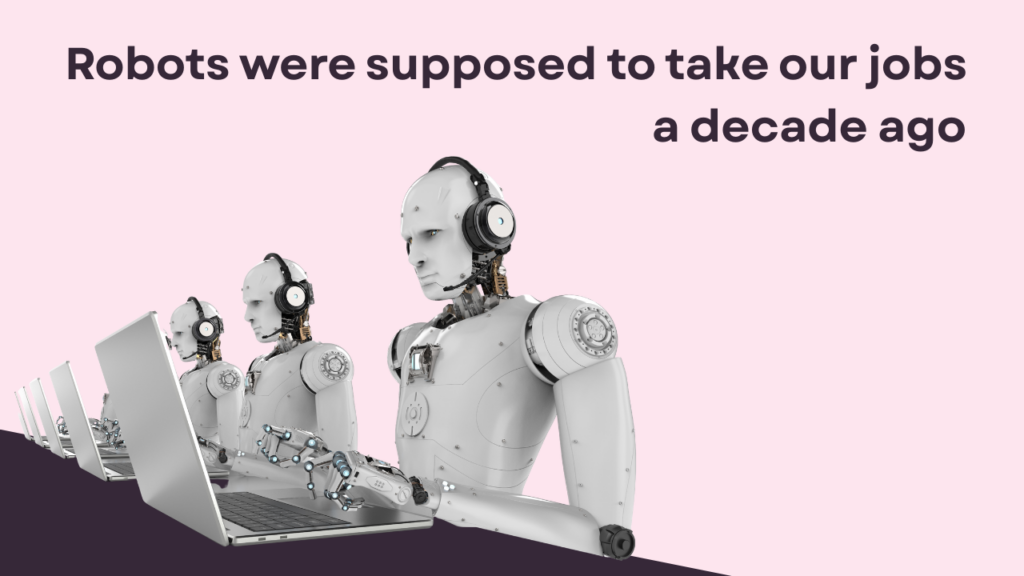
In 2015, Martin Ford published Rise of the Robots: Technology and the Threat of Mass Unemployment. It won the Financial Times and McKinsey Business Book of the Year. It argued, with serious evidence and serious credentials, that a wave of software automation — what most of us came to call RPA — would hollow out the white-collar workforce within a generation. Accountants were on the list. So were paralegals, radiologists, junior analysts, and most of the back office of financial services.
I was working in enterprise automation when that book came out. I read it. I took it seriously. So did the boards I was advising. The forecast wasn’t fringe — it was mainstream, well-evidenced, and delivered by people who had thought hard about what the technology could do. A decade on, almost none of it came to pass.
This matters now because we are watching the same script staged again. At Accountex London, a panel of leaders from IFAC, ICAEW and ACCA spent an hour on whether generative AI will replace the accountant by 2030. The doom-stories have a new technology, the same structure, and many of the same headline writers. And underneath it sits the only question that actually matters: if the last revolution didn’t do what we said it would, what does that tell us about this one?
Two schools of thought
The first is that the doomers are eventually right, just early. Ford wasn’t wrong on the technology, he was wrong on the timeline. RPA didn’t deliver mass unemployment because it turned out to be more fragile, more limited and more expensive to maintain than the coverage suggested. But the trajectory of capability is real, and generative AI is a genuine step-change in what machines can do with unstructured information — which is most of what knowledge workers actually do. On a long enough horizon, the pattern of “technology evolves the work rather than ending it” might simply break.
The second is more interesting: the doomers weren’t just early, they were wrong about why. In most cases the technology delivered what its vendors promised. The unemployment wave didn’t arrive because the deployment wave didn’t arrive. Citizen-developer automation generated technical debt that often consumed more than half of the internal team’s time. Processes that looked clean on a map turned out to be held together by tribal knowledge and undocumented exceptions. Governance lagged deployment by years. Change resistance was rational, because the people being automated had figured out the bot couldn’t handle the edge cases they handled every day. The technology was capable of more than the institutions deploying it could absorb. That’s not a story about RPA. It’s a story about us.
The Accountex panel got it nearly right
To their credit, the leaders on stage were not catastrophising. The ICAEW shared something revealing: only 17% of firms say they can accurately assess the impact of AI on their people, and 34% admit they have no idea how AI will affect their headcount. Eighty per cent believe the role is shifting from compliance toward ethical judgement and advisory work.
Drowning in manual, repetitive work? Tell us the task and we’ll show you what to automate.
Read those numbers carefully. They don’t describe a profession being eaten by AI. They describe a profession that hasn’t yet developed the instruments to measure AI’s effect on itself. Michelle Cardwell of IFAC made the point that the spreadsheet, predicted in the 1980s to kill the profession, instead expanded it. The panel’s read on the next five years — more advisory, more multi-disciplinary teams, more fluidity between practice and industry — is roughly the right shape. But the panel didn’t quite name why the evolution-not-evaporation pattern keeps repeating. It’s not that the work is too human for AI. It’s that human institutions absorb new tools slowly, partially, and on their own terms — and the deeper the tool reaches, the more friction it generates. That friction is the immune response of an organisation discovering the new technology requires it to redesign work that’s been stable for a generation.
What I’d tell a firm planning for 2030
Don’t pick a school of thought. Pick a posture. Assume the doomers might be right on the long horizon — not because they probably are, but because the cost of being wrong about that is asymmetric. Plan for a five-year window in which the work, the headcount mix and the entry-level role all change substantially. Then assume the second school is right on the short horizon: the firms that win won’t be the ones who buy the most AI, but the ones who do the unglamorous work of redesigning around it — rebuilding the training pathway, governing the technology before it embeds where no one can untangle it, measuring impact rather than guessing, and refusing to mistake tool adoption for transformation.
Where the real risk sits
If you take the first view, the temptation is to brace for impact and treat AI as an existential threat, which produces defensive purchasing and strategic paralysis dressed up as prudence. If you take the second, the temptation is to assume the friction will protect you — a more sophisticated complacency, but complacency all the same.
The real risk is the fat middle: firms hollowing out the entry-level base while keeping the management tier intact, because AI and offshoring handle the transactional work that used to be how trainees built the instinct for when a number looks wrong. It isn’t a doom scenario. It’s a slow erosion of the apprenticeship model that built the profession’s judgement in the first place — caused not by AI, but by firms making locally rational decisions that aggregate into a sector-level problem a decade out. The technology doesn’t do the damage. Our decisions about how to deploy it do.
Daniel Lawrence is the Founder and CEO of Bots For That, an AI-native company serving the UK accounting and bookkeeping profession. He has spent over a decade deploying enterprise automation in regulated industries, including finance and accounting.