
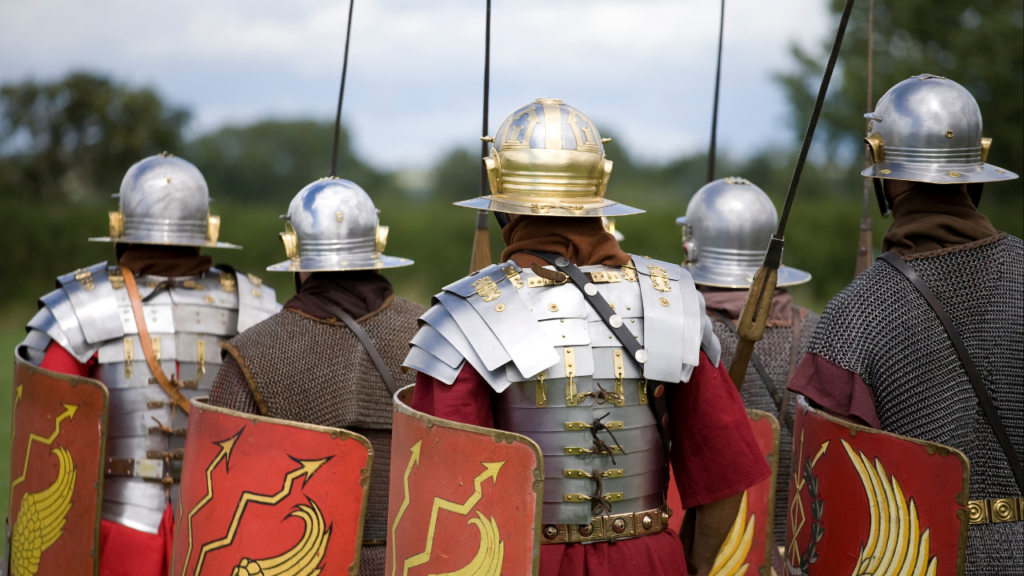
The Roman Legion Problem
What if the org chart is the bottleneck?
Part 1 of The Self-Improving Firm: a nine-part series on what AI-native looks like for a UK accounting firm
The modern accounting firm is organised like a Roman legion.
Information moves up the hierarchy. Decisions move down. Humans sit at every level acting as conduits, taking inputs from below, applying judgement, and passing outputs further up or back down again. Juniors prepare. Seniors review. Managers consolidate. Partners decide. The structure is so familiar it barely registers as a structure at all. It is just how a firm works.
It is also two thousand years old.
The Roman legion was an astonishing organisational achievement. It coordinated tens of thousands of soldiers across multiple continents using nothing but human messengers, written orders, and a rigid chain of command. Every level of the hierarchy existed for a reason: information had to be physically carried, summarised, judged, and acted upon by a person, because there was no other way to move it. The legion was the most sophisticated information-processing system in the ancient world.
Modern firms inherited the shape of that system. They built on top of it with telephones, fax machines, email, practice management software, Microsoft Teams. Each new tool sat inside the structure rather than replacing it. The legion stayed intact.
The question this series opens with is whether that is still the right shape.
What the structure is actually for
Before pulling at any of this, it is worth being honest about why the hierarchy exists in the first place. It is not arbitrary. It is not, as the more enthusiastic startup commentators sometimes suggest, simply a failure of imagination. The accounting firm pyramid does at least four things that the firm genuinely needs done.
It moves information. A query from a client gets summarised by a junior, contextualised by a senior, escalated to a manager, presented to a partner. Each layer compresses and filters. By the time the partner sees it, the question has been pre-digested.
It allocates judgement. Different decisions sit at different levels. A junior cannot sign off on a set of accounts. A partner does not need to be involved in choosing a default VAT code. The hierarchy is, among other things, a permissions system.
It trains people. The pyramid is also a school. Juniors learn by doing the basic work under supervision. Seniors learn by reviewing juniors. Managers learn by running engagements. Partners learn by handling clients. The career path and the production line are the same thing.
It distributes risk. When a partner signs a set of accounts, they are taking personal regulatory responsibility for work that has passed through multiple sets of hands. The hierarchy is also a chain of professional accountability that satisfies the ICAEW, ACCA, HMRC, and the firm’s insurer.
Any conversation about restructuring the firm that does not take all four of these seriously is not worth having. The pyramid is load-bearing in ways that look invisible until you remove something and the roof comes down.
What is changing underneath it
The hierarchy was built for a world in which moving and processing financial information required humans at every step. That world is ending.
A modern AI system can ingest a year’s worth of bank transactions, supplier invoices, expense claims, and payroll data, reconcile them, identify anomalies, draft journal entries, and produce a first-pass set of working papers in minutes. It can read a lease agreement and pull out the relevant accounting treatment. It can compare this year’s management accounts against last year’s and write the variance commentary. It can answer most of the questions a junior would have asked a senior, by reading the firm’s previous answers to similar questions.
This is not a prediction. This is what the technology does today, in firms that are using it. The technology will get better. The cost will fall. The capability will spread.
What this means for the hierarchy is straightforward, even if the implications are not. The information-moving function of the pyramid was its primary function. It is the thing the structure was designed around. And it is the function AI is best at absorbing.
Bolt AI onto the existing legion structure and the result is a marginally faster legion. The juniors prepare faster because they have a copilot. The seniors review faster because they have a summary. The managers consolidate faster because the reports write themselves. The partners decide faster because the briefings are pre-prepared. Productivity goes up by perhaps twenty percent, which is what every firm currently piloting AI is reporting.
That is not nothing. But it is also not what the technology is capable of.
The deeper question
The harder question is what the firm would look like if you took the information-moving function out of the human hierarchy entirely.
Not “AI assists the junior”. AI does the work the junior was doing. Not “AI helps the manager consolidate”. The consolidation happens automatically and the manager reviews the output. Not “AI drafts the partner’s briefing”. The briefing exists continuously, queryable on demand, with no preparation step.
What does the firm look like then?
The pyramid does not collapse, because the other three functions of the hierarchy, judgement allocation, training, and risk distribution, are still needed. But they are no longer welded to the information-moving function. They can be reorganised.
Judgement allocation becomes a question of which decisions actually require human judgement, and at what level of seniority. Some are obvious: the new-client pitch, the difficult conversation with a struggling business, the marginal disclosure call, the negotiation with HMRC. Others are less obvious. Does setting a fee for a recurring compliance engagement require a partner? Does reviewing standardised working papers require a manager? Does answering routine client queries require a senior? Each firm will answer these differently. But the answers are no longer dictated by who happens to have the information.
Training becomes a question of how people learn the profession when the basic preparation work is no longer the entry point. This is the most difficult problem in the entire conversation, and the one the profession has barely started thinking about seriously. If juniors are not learning by preparing files, what are they learning by? Who teaches them? How do they qualify? How do they become partners? These are not rhetorical questions. The current answers do not work without the pyramid that produced them.
Risk distribution becomes a question of how regulatory accountability survives in a firm where significant amounts of work are being done by systems. The partner still signs. But the chain of human review behind that signature is shorter, and the responsibility for the parts of the work that AI did has to land somewhere. The professional bodies are starting to think about this. The regulators and insurers will catch up quickly.
These are not insurmountable problems. They are the actual problems. They are also the problems no current AI vendor is helping firms solve, because they are not technology problems. They are firm problems.
The shape of the question
This is the question the series will spend the next eight parts working through. Not “should you use AI”. Not “which AI tools should you buy”. Both are now uninteresting questions, and most firms have moved past them, even if they would not admit it publicly.
The interesting question is what shape the firm should be in five years, given that the information-moving function the current shape was built around is no longer a primarily human activity. The series will work through that shape piece by piece. The sensor layer that replaces the information-gathering function. The decision layer that replaces the consolidation function. The closed-loop learning system that replaces the annual review cycle. The new role definitions that replace the manager-coordinator function. And the work that stays unambiguously human.
None of it is straightforward. Some of it will be uncomfortable. All of it deserves a more serious conversation than the profession is currently having.
A closing observation
The Roman legion did not lose its dominance because someone invented a better hierarchy. It lost its dominance because the world around it changed in ways the hierarchy was not designed for. Heavy cavalry. Decentralised raiding. Logistics that did not respect the supply chain a marching army required. The legion was still extraordinarily good at what it did. The thing it did was just no longer the thing that mattered most.
The accounting firm pyramid is extraordinarily good at what it does. It has been refined over generations and it satisfies every professional, regulatory, and commercial requirement the industry has placed on it. The question is whether what it does is still the thing that matters most.
That is the question the series will not answer for any individual firm. But it is the question every managing partner should now be asking out loud, with their leadership team, in front of a whiteboard, for at least one afternoon.
If you have not had that conversation yet, you are behind firms that have. If you have had it and concluded the answer is no, fair enough. But have it. Have it deliberately. Have it with people who will push back honestly. And come out of it with a position you can defend, not a position you have inherited.
The legion was the right answer for a very long time. That does not mean it is the right answer forever.
Daniel Lawrence is the CEO and co-founder of Bots For That and creator of the automation operating system. He has spent more than a decade deploying enterprise automation and AI in regulated industries including accounting and professional services. The Self-Improving Firm is a nine-part series exploring what AI-native operations look like for mid-tier and large UK accounting firms.

Part 2, Burn Tokens Not Headcount, asks what happens when recruitment cost and compute cost become directly comparable line items on a partner P&L.