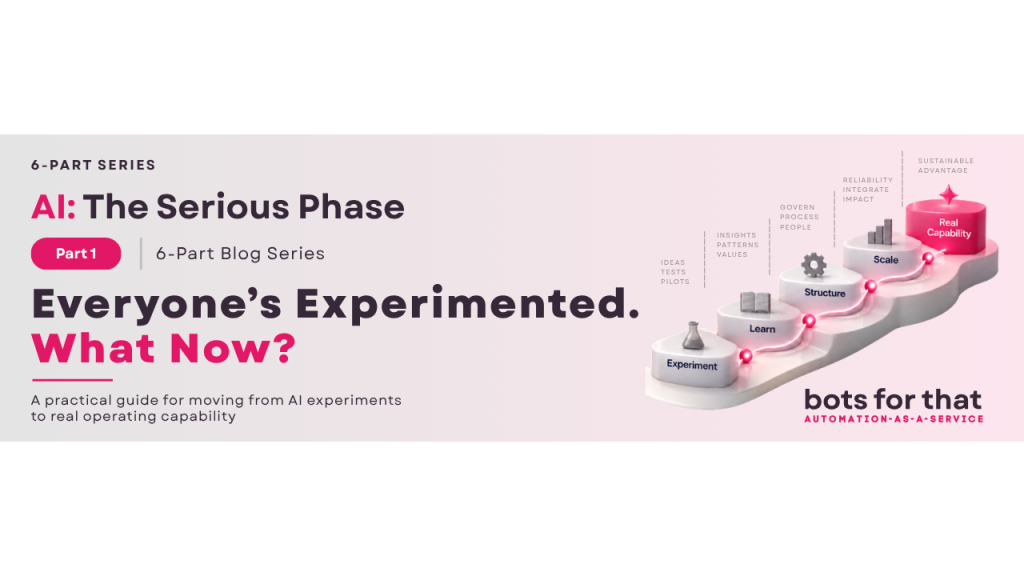
Everyone’s Experimented. What Now?
Pretty much every business has been through the same three moves.
Someone tried ChatGPT because everyone else was talking about it. IT blocked everything and then quietly switched on CoPilot or Gemini for the office suite because it came bundled with the licence anyway. A few people, usually the curious ones, went further (albeit, unauthorised in many cases): Claude, Grok, a couple of niche tools, mostly out of interest rather than instruction.
It’s how every new technology cycle starts. Innovators poke at it. Early adopters follow once it looks safe. Late adopters arrive once it’s simply expected. By 2026, almost every business, regardless of size or sector, has been through some version of this. The Laggards will eventually show up, maybe.
Which means the exploration phase of AI is functionally over.
Not because there’s nothing left to try. There’s plenty. But because the defining question of the last three years, “are we using AI”, has stopped being useful. Everyone is using AI. That’s no longer a signal of anything.
The tools got really good, really fast. That’s the problem.
The tools are now good enough to be genuinely dangerous. And not just the leading frontier models either.
Not dangerous in the dramatic sense, but in the quiet, unassuming sense. They’re fluent, confident, fast, and increasingly capable of taking on real work as workflow agents, rather than just drafting an email or summarising a document. I think that competence is lulling a lot of businesses into a false sense of security.
If the output looks polished, it’s easy to assume the process behind it is sound. It often isn’t. A tool producing a confident answer tells you nothing about whether anyone can explain how it got there, what data it touched, who’s accountable if it’s wrong, or what happens when three more of these tools are running loose and unsupervised around your organisation.
Playing with AI was low stakes. Operating on it is not.
What “getting serious” actually means
Getting serious about AI isn’t about buying more tools, or hiring more AI specialists, or running another pilot. Most businesses have already proven the technology works. That question is answered.
The unanswered question is whether the organisation can manage what it’s built, before it builds even more.
That’s a different kind of work entirely. It’s less exciting than picking a new tool and more important than almost anything else in the AI conversation right now. It sits across five areas, and none of them are optional if AI is going to move from “something people use” to “something the business runs on”.
Drowning in manual, repetitive work? Tell us the task and we’ll show you what to automate.
In my humble opinion, the five key areas that businesses simply must be working on now for their AI program, no matter how mature, are these:
AI Governance. A written policy telling staff how to use AI responsibly is not a control. It’s a hope at best, and it’s hugely inadequate. If the actual configuration, access, and data controls aren’t structurally enforced, the policy document is just something to point to after something’s gone wrong.
AI Literacy. The instinct is to hire AI specialists. The better move, in most cases, is making the people who already understand the business dangerously good with AI. Domain knowledge plus AI fluency beats AI fluency without domain knowledge, almost every time. It’s always been this way. It’s been this way for the last ten years with process automation, and it’s the reason the most successful automation programs were resourced up with subject matter experts.
AI Tokenomics. Pilots are cheap. Scale isn’t. The economics of AI change the moment usage grows, and most businesses haven’t done the sums on what happens when ten users becomes a thousand queries a day. This needs a deliberate conversation now with your cost models clearly understood, to avoid a major surprise later.
AI Lifecycle & Agent Structure. An agent that’s useful today won’t stay useful forever without review. It needs onboarding, monitoring, and eventually retirement, in the same way a person would. Left alone, agents don’t maintain, sustain or retire themselves. They just quietly become the thing nobody remembers building. And the trick is to avoid the build up of technical debt and shadow AI teams.
AI Agent Control & Orchestration. Ten agents can be managed on goodwill and a spreadsheet. A hundred can’t. At some point every business needs one place where it can see what agents exist, who owns them, what they’re touching, how they’re performing and what they’re doing right now.
Why does this need to happen now
None of this is speculative. It’s the direction the analyst conversation is already moving. McKinsey’s recent work on AI performance management makes largely the same case from a slightly different angle: they believe the challenge has shifted from deployment to management, and the businesses that treat AI as a new category of worker, rather than a new piece of software, are the ones that will actually see the returns.
That’s the shift this series is about. Not more tools. Not more experimentation. The unglamorous, structural work of making AI something a business can actually run, govern, and be accountable for.
Over the next few instalments we’ll take each of the five areas in turn: what’s actually broken in how most businesses are handling it today, and what doing it properly looks like in practice. And this is no theoretical thesis. I’m basing this on the real-life situations of all of the customers we work with, with the prospects we talk to and who share their stories, and with other businesses that we exchange insights with.
The exploration phase gave everyone a taste of what AI can do. And what it can’t. The serious phase is about proving you can be trusted to run it.
Next in this series: Part 2, AI Governance, and why the policy on your shared drive isn’t doing the job it should be.
Daniel Lawrence is the CEO and co-founder of bots for that, creators of the Automation Operating System (AOS) and Agent Console. He has spent more than a decade deploying enterprise automation and AI in regulated industries including accounting and professional services. AI: The Serious Phase, is a six-part series exploring what AI-native operations look like for mid-tier and large UK accounting firms.