For more than a decade, Bots For That has delivered automation into businesses where a mistake has consequences: regulated, audited, complex, and short on patience for experiments that go sideways. Accounting is now in that position. Many of the patterns we saw elsewhere are showing up in it, with rather more noise.
BCG’s (Boston Group) Applied AI Index 2026 [BCG ARTICLE], a survey of 1,330 CxOs and senior leaders across 20-plus sectors, puts numbers on what we have been watching. Almost half of the companies in it now generate value from AI. Only 7.5% are the most AI-mature, and another 41% are scaling. The rest are still working out where to start.
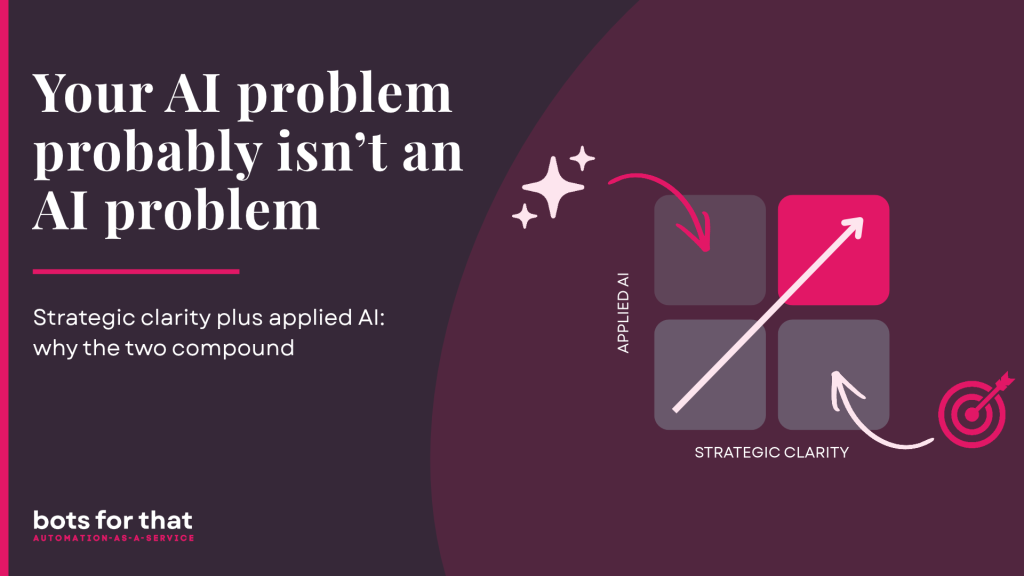
The finding that matters most is how value arrives. BCG measured value realised through AI as a share of revenue, against two things: strategic clarity (a few big, owned, measured bets) and applied AI (controls, workforce redesign, an agent-ready data platform).
| Low strategic clarity | High strategic clarity | |
| High applied AI maturity | 2.0% | 4.5% |
| Low applied AI maturity | 0.9% | 1.8% |
Add the two middle results to the baseline and you would expect about 2.9% for “both high”. The actual figure is 4.5%. The two dimensions compound rather than add. Tools alone do not get you there, and neither does clarity alone.
Source: BCG, The Formula for Agentic AI Value: The Applied AI Index 2026 (n = 1,330). Self-reported by senior leaders; see caveats at the end.
What we’ve seen in other regulated markets
Across regulated and complex markets the pattern has been consistent.
- The early winners did not have the best models. They had the clearest answer to “who is accountable when this is wrong?”
- Value arrived at the workflow level, not the tool level. One workflow, taken end to end, beats ten tools taken halfway.
- Controls came first, and speed followed. Firms that agreed the guardrails up front moved faster later, because nobody had to stop and ask permission to continue.
BCG’s examples point the same way. Its double-digit gains came where a core workflow was taken to scale: credit decisioning in banking, claims-fraud detection in insurance, demand forecasting in consumer goods. None of those is a chatbot.
Accounting’s own regulator works like this. HMRC pairs algorithmic flagging with human accountability at the point of decision. If that operating model is good enough for the Revenue, it is a reasonable place for a firm to start.
The three pathways we see in accounting
Most firms we meet have chosen one of these, whether or not they would call it a choice. Each is rational. Each also fails in a predictable place.
1. Controlled experimentation
A small team, a sandbox, a steering group, careful notes.
- What is right about it: it is cautious, it protects client data, and it produces real learning.
- Where it stalls: it becomes permanent. Among BCG’s most AI-mature companies, 61% have moved from isolated pilots to a multiyear, enterprise-wide programme. A pilot that never graduates is a hobby with a budget.
2. Long arms-length, with suspicion
Watch, wait, and let others find the problems.
- What is right about it: much of the scepticism is earned, and some vendor claims deserve every bit of it.
- Where it stalls: the gap compounds. In BCG’s data, 44% of the most AI-mature companies already realise value from agentic AI, against 2% of laggards. Meanwhile your people are probably using AI anyway, just not the sort you approved.
3. Open embrace of new AI-embedded apps
Every new product with “AI” in the release notes gets a trial.
- What is right about it: it is fast, and some of these products are genuinely good.
- Where it stalls: this is maturity without clarity, the 2.0% box. BCG reports that 80% of corporate AI spend now sits outside the enterprise IT budget. That is how a firm ends up with nine tools, no owner and a data trail nobody can reconstruct.
The uncomfortable part is that all three paths fail in the same place. None of them starts by deciding what the firm is trying to change.
What BCG says to do next
BCG’s survey results split the advice by starting point, which is useful because the three pathways above map reasonably well. This mapping is our reading, not BCG’s.
- Arms-length firms sit closest to BCG’s laggard stage. The advice is to establish foundations: bundle AI efforts into one multiyear programme, put clear ownership and value measurement in place, keep humans as the final decision-maker, and set up guardrails, audits and escalation routines.
- Controlled experimenters are usually between laggard and scaling. The task is to graduate: pick fewer, higher-value workflows, take each end to end, and dedicate people to AI rather than borrowing them.
- Open embracers are often already scaling, without the clarity to match. BCG’s advice here is to concentrate investment on fewer workflows, rationalise the vendor landscape, and tie spend to business outcomes.
Different starting points, same underlying move: decide what matters, name who owns it, and measure it.
Small firms and large firms should set out different stalls
BCG’s sample leans towards large enterprises, so its advice needs translating.
Drowning in manual, repetitive work? Tell us the task and we’ll show you what to automate.
Smaller firms
- Clarity is your advantage. Fewer partners and shorter decisions mean one conversation can settle it.
- Pick two or three workflows and leave the rest alone.
- You will not run an enterprise control plane, so choose tools whose controls are already configured, and ask what they log.
- Name one accountable partner. Not a committee.
Larger firms
- Governance complexity does not scale in a straight line. Multiple offices with divergent habits, management distance from what people actually do with AI, and a footprint layered by acquisitions all compound.
- BCG’s instinct of one programme with clear C-suite ownership is right.
- Resist the single-vendor stack. BCG notes that more than two-thirds of the most AI-mature companies commit to one enterprise-wide platform with a common architecture and control plane, not one supplier.
- Track P&L value, not proxy KPIs such as hours of assistant usage.
Gesture governance versus structural governance
Most governance we see is gesture governance: the policy PDF, the training session, the “please be careful” email. Structural governance is actually configured: data source controls, guardrails, audit trails and escalation routes that work whether or not anyone remembers the policy.
BCG found that only 5% of companies have the full set of critical controls in place, yet 42% expect to grant agents autonomy by 2030. Companies with all six controls generate three times as much agentic value as those with one.
Controls are not the brake. They are how you get to go faster.
Before you add AI, remove the work
We use ESSA: Eliminate, Simplify, Standardise, Automate. AI comes after all four.
Our estimate, from more than a decade of this, is that up to 80% of accounting work is deterministic. It needs a rule that runs the same way every time, not a model. Using a large language model for that is expensive and occasionally creative, which is not what you want in a VAT return.
The approach that holds up is a hybrid:
- Deterministic automation executes.
- AI handles the unstructured, messy parts.
- Humans own the exceptions and the decisions.
BCG’s 10-20-70 model says the same thing from the other end: 10% of the effort goes into algorithms, 20% into technology and data, and 70% into people, organisation and process.
Three questions for Monday
- Which three workflows would change the firm’s P&L if they worked end to end?
- Who is accountable for each, by name?
- What would we measure to know?
- If the partners cannot answer those in the same room, the problem is not the technology.
Caveats
BCG sells transformation programmes, and its conclusions are the sort of thing a transformation programme addresses. The data is self-reported by senior leaders, and “strategic clarity” is a subjective rating. Causality is asserted rather than shown: firms already seeing results may simply rate themselves as clearer. Treat the percentages as directional.
The direction matches what we see.
Over to you
Which of the three pathways is your firm on, and would your partners give the same answer?
Get in touch / book time with Daniel. Automation Checkup Meeting